
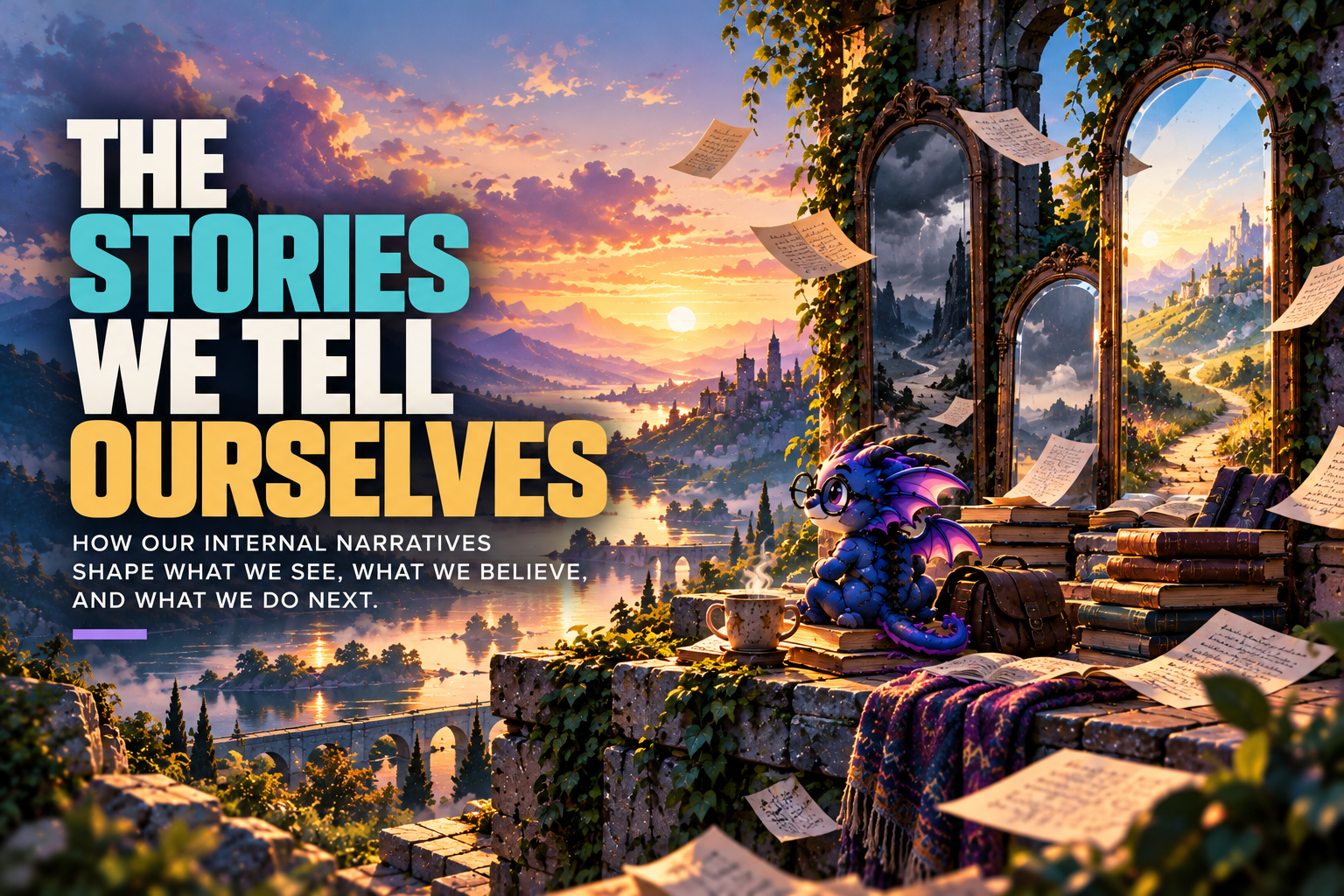
The stories we tell ourselves
I’ve spent most of my adult life questioning things. Systems, assumptions, conventional wisdom, established practices, and the occasional expert who seems personally offended by the suggestion that something might work differently.
It’s not that I automatically assume everyone else is wrong. I just don’t believe something becomes true simply because enough people have agreed to stop questioning it.
Over the past three and a half years, though, I’ve become considerably more ruthless about it. I’ve become less willing to accept explanations that don’t hold up under scrutiny. Less interested in preserving assumptions simply because they’re familiar. And far less inclined to organize my life around expectations I never consciously agreed to.
Some of that has come from experience, some from necessity, and some from discovering that the stories we tell ourselves about how the world works, who people are, and what we’re responsible for can survive remarkably long after the evidence supporting them has disappeared.
I’ve had a rather expensive education in that particular subject. The tuition was astronomical, the curriculum wasn’t disclosed in advance, and I would very much like to speak to someone about the refund policy.
Unfortunately, there doesn’t appear to be a registrar.
For more than three years, I’ve been navigating circumstances that have challenged nearly everything I thought I understood about people, institutions, relationships, and even myself. I’m not going to unpack all of those circumstances here. The details aren’t necessary to understand what I’ve been examining.
What interests me is how much of our lives rests on assumptions we’ve never actually tested.
We believe certain people will be there when we need them because they’ve always been there before. We assume relationships carry particular obligations because that’s how we’ve understood them for years. We accept that certain systems operate the way they do because someone, somewhere, decided that was the appropriate way to do things.
And we build entire lives around those beliefs. Until something happens that forces us to look more closely.
One of the more uncomfortable discoveries I’ve made is how little we sometimes know about the people we think we understand.
When things started happening, some people I expected to remain in my life disappeared. Others stayed when I wasn’t particularly confident they would. And some people I never expected much from showed up in ways that surprised me.
I could spend an enormous amount of time trying to understand why. But eventually, I started asking a different question.
Do I actually need to know why someone made a particular choice in order to decide what I’m going to do with it?
Sometimes, yes. Understanding another person’s circumstances can change how we interpret their behavior. There are legitimate reasons people struggle to show up for one another, especially during difficult situations.
But sometimes the answer is no.
Sometimes I can acknowledge what happened, recognize that I don’t have the whole story, and decide how much of my time, attention, and emotional energy I’m willing to invest going forward. I don’t have to turn someone into a villain to change the role they occupy in my life. And I don’t have to construct an explanation for every disappointment.
But examining my assumptions about other people has also forced me to examine something closer to home: the responsibilities I’ve assigned myself within those relationships.
Because it’s one thing to discover that someone isn’t who you believed them to be. It’s another to recognize that you’ve been organizing your own behavior around expectations you never stopped to question.
I’ve always been fairly comfortable disappointing people and I’ve never been especially interested in winning popularity contests. I learned a long time ago that attempting to keep everyone happy is an excellent way to make yourself miserable.
But there’s a difference between being willing to disappoint someone and recognizing that their disappointment may not be yours to manage in the first place.
I’ve become much more deliberate about asking myself why I’m responding to something the way I am.
Am I upset because this situation genuinely conflicts with my values? Or am I absorbing someone else’s emotional response?
Am I agreeing to something because I believe it’s important? Or because someone expects me to?
Is this actually my responsibility? Did I choose it? And if I did, would I still choose it today?
Those questions can be uncomfortable, especially when the answers challenge relationships or patterns of behavior we’ve maintained for years. But they can also reveal something rather astonishing: how much of our lives we spend responding to expectations that may not even exist outside our own assumptions.
We imagine what someone wants from us, anticipate their disappointment, and construct an obligation around that imagined response. Then we rearrange our priorities to accommodate it. At no point does anyone necessarily ask us to do any of this.
We’ve essentially created an entire administrative department for managing other people’s hypothetical feelings. And somehow, we’re the only employee.
I’ve also become more selective about whose opinions I allow to influence my decisions.
There’s an old saying that what other people think of you is none of your business. I’ve always appreciated the sentiment, but these days I understand it differently.
It doesn’t mean I don’t care about people. I care deeply about the people I love, and their experiences, perspectives, and feelings are important to me. But caring about someone doesn’t automatically give their interpretation of my life authority over my own.
Even the people closest to me don’t get to decide what I believe, what I value, or what I know to be true about myself. Sure, their perspectives can inform my thinking, they can challenge me, they can help me see something I’ve missed.
That’s part of what makes those relationships valuable.
But there’s a difference between considering someone’s perspective and surrendering your judgment to it. And the further someone is from the center of my life, the less influence I’m willing to give their opinions.
That may sound harsh to some people. I’m comfortable with that. Because the alternative is allowing an unlimited number of people, many of whom have only fragments of information about my life, to participate in decisions they won’t have to live with.
No, thank you.
What’s particularly interesting is how closely this mirrors the work I’ve spent decades doing with businesses and organizations.
One of the most common problems I’ve encountered is the tendency to improve an existing process without questioning whether the process itself still makes sense.
People ask how to make something faster, cheaper, more efficient, or easier to manage.
Sometimes that’s exactly the right question. But sometimes the better question is why we’re doing it at all.
I’ve occasionally joked that I’m so far ahead of other people they think I’m behind.. .. by the time they’re finishing their first lap, I’ve already completed three.
There’s some humor in that, but there’s also genuine frustration in recognizing how difficult it can be to challenge a framework when everyone else is still using that framework to evaluate your thinking.
And I’ve come to recognize that the same thing happens in our personal lives.
We keep trying to improve relationships without questioning the assumptions they’re built on. We try to manage obligations more efficiently instead of asking whether they belong to us. We search for better ways to meet expectations without considering whether those expectations deserve our attention.
We become extraordinarily skilled at maintaining arrangements we never stopped to examine.
Over the past three and a half years, I’ve had to reconsider a great many of those arrangements. Not because I suddenly stopped caring about people or became someone fundamentally different. If anything, I think I’ve become more aware of what I genuinely care about.
But I’ve become less willing to confuse caring with obligation, familiarity with truth, or someone else’s interpretation with my own reality. And I’ve become increasingly aware of how often the stories we tell ourselves are constructed from incomplete information.
We do it with other people, with institutions, with the world around us. And perhaps most persistently, we do it with ourselves.
We decide who we are, what we’re capable of, what we owe, what we deserve, and what our lives are supposed to look like. Then we reinforce those conclusions through the choices we make.
Sometimes those stories serve us well. Sometimes they were never particularly accurate to begin with. And sometimes they were true once, but we’ve changed, the circumstances have changed, or we’ve learned something that makes the original explanation less convincing.
Challenging an assumption doesn’t necessarily mean rejecting it. Sometimes, after examining it carefully, we discover it still holds up. But at least we’ve made that determination consciously. At least we’ve considered whether the story we’re living inside is one we still believe.
And perhaps that’s the question I’ve become most interested in asking:
How much of what I believe about my life is based on what I actually know, and how much is based on a story I’ve simply never thought to question?
I don’t expect to finish answering that anytime soon.
In fact, given what the past three and a half years have taught me, I’m becoming increasingly suspicious of answers that arrive too neatly.
Especially my own.

Hey, it’s Lee
I’m a writer, strategist, and professional question-asker who has spent more than two decades helping people and organizations make sense of complicated things. I write about life, work, human behavior, and the systems we build, inhabit, and occasionally need to dismantle. I’m also particularly fond of unconventional thinking, good coffee, and asking, “And then what?”